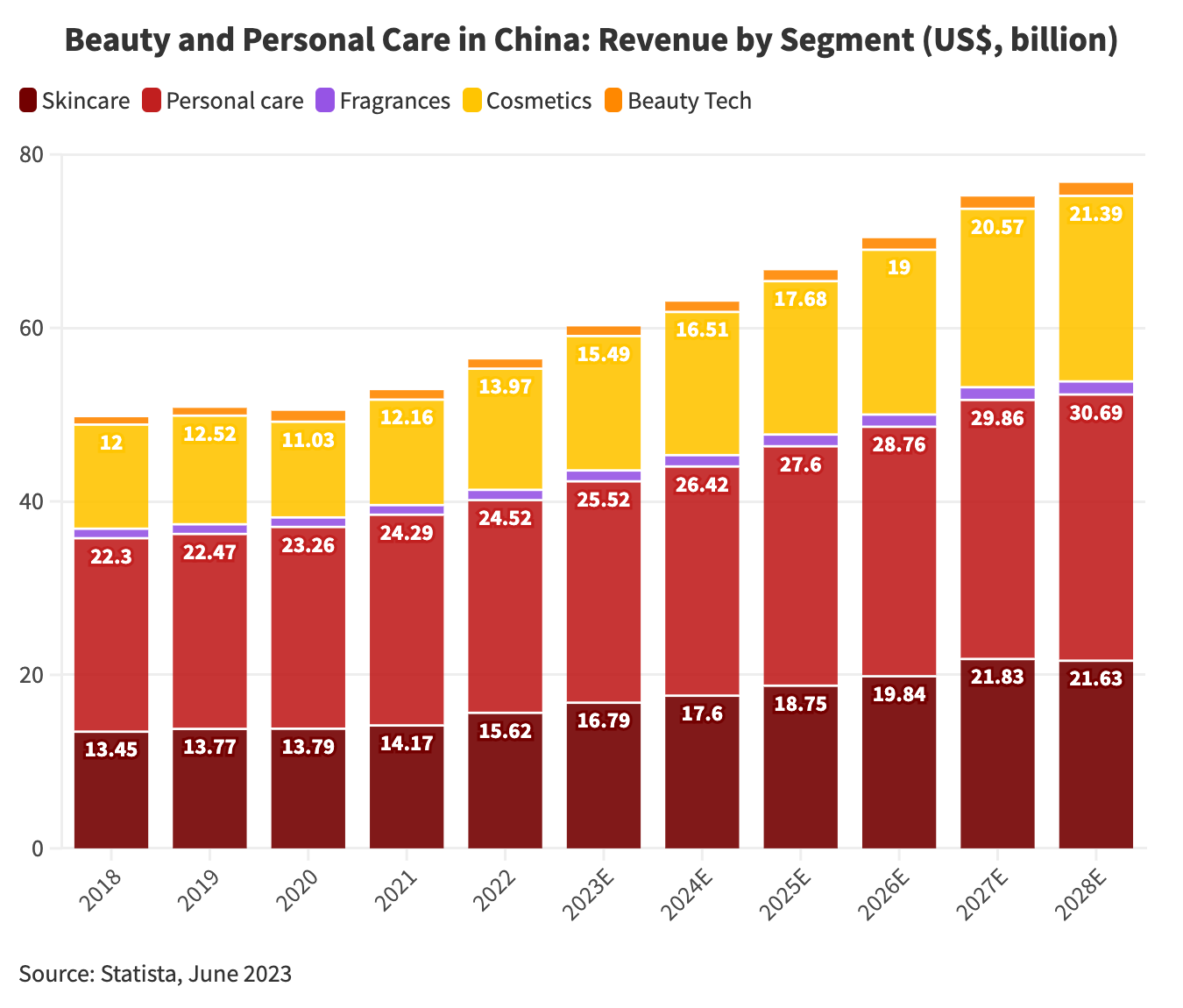



China’s beauty and personal care industry is expanding rapidly and is expected to approach US$78 billion in value by 2025. The country already ranks among the largest beauty markets globally and continues to be the main engine of growth across Asia.
China’s cosmetics and personal care sector has grown into one of the most dynamic consumer markets in the world. Industry forecasts suggest the market could generate close to US$78 billion in revenue by 2025, reinforcing its status as a major global hub for beauty consumption.
Within the Asia-Pacific region, the country is expected to contribute nearly 70 percent of regional growth over the next few years. This strong momentum is supported by rising incomes, digital retail expansion, and changing consumer lifestyles that place greater emphasis on self-care and wellness.
The sections below explore the current structure of the market, the regulatory landscape shaping the industry, evolving consumer preferences, and the opportunities that remain for overseas businesses interested in entering this rapidly developing sector.
Market overview
The beauty and personal care industry covers a broad range of consumer products designed for skin, hair, and general personal grooming. Typical categories include facial cosmetics, skincare items, fragrances, and daily care products such as shampoos, deodorants, and shaving products. Technology-driven beauty devices are also becoming increasingly common in the market.
Market research suggests that total revenue from beauty and personal care products could reach approximately US$73.66 billion by 2025. Over the following five years, the industry is projected to maintain steady expansion with a compound annual growth rate of around 3.7 percent.
The personal care segment alone is expected to exceed US$30 billion in annual revenue, reflecting strong demand for everyday grooming products and hygiene-related items.
Online sales are also becoming a dominant distribution channel. By 2025, digital platforms could account for roughly 25 percent of total market revenue. Social commerce, livestream shopping, and mobile-first purchasing habits have all played a significant role in this shift.
Another key factor behind market growth is the continued expansion of the middle-income population. As purchasing power increases, many consumers are moving toward higher-quality and premium beauty products. At the same time, buyers remain cautious about price, which has encouraged brands to introduce entry-level luxury products and more personalized marketing strategies.
Regulatory environment
The beauty and personal care industry operates under a structured regulatory system that focuses on product safety, quality control, and consumer protection. Several government bodies are responsible for supervising different parts of the product lifecycle.
Main regulatory authorities
National Medical Products Administration (NMPA)
This authority oversees product safety and technical supervision throughout the entire lifecycle of cosmetic products. Key responsibilities include:
- Product registration and filing
- Manufacturing licensing
- Quality supervision and inspection
- Safety monitoring and evaluation
Local regulatory departments assist with implementation by reviewing documentation, conducting inspections, and investigating potential compliance violations.
State Administration for Market Regulation (SAMR)
This body is responsible for broader market supervision, including:
- Oversight of distribution channels and retail activities
- Regulation of advertising claims
- Consumer protection and complaint handling
It also collaborates with other regulators to address counterfeit products and illegal additives.
General Administration of Customs (GAC)
Customs authorities supervise the import and export of cosmetics, ensuring products entering the market comply with national safety standards.
Regulatory updates
The regulatory system has undergone significant modernization in recent years. The most influential framework is the Regulations on Supervision and Administration of Cosmetics, introduced to strengthen safety management and clarify responsibilities across the industry.
Compared with earlier rules, the updated framework introduces clearer procedures for product registration and market supervision. While compliance standards have become stricter, the revised system also offers greater transparency for companies entering the market.
One important policy change is the shift toward simplified filing procedures for many general cosmetic products. This replaces the older approval system and reduces administrative complexity in certain cases.
In addition, several regulatory updates introduced between 2024 and 2025 highlight a stronger focus on safety monitoring and ingredient management. A key example is the requirement that complete cosmetic safety-assessment reports must be submitted starting May 1, 2025. This rule emphasizes comprehensive product documentation and stricter scientific evaluation.
Authorities are also introducing improved risk-monitoring mechanisms that track products throughout their lifecycle, including post-market safety surveillance and adverse reaction reporting.
Overall, the regulatory trend points toward higher compliance standards combined with clearer guidance, creating a more structured environment for companies operating in the sector.
Consumer behavior and preferences
Consumer demand in the beauty and personal care industry continues to evolve as demographics, income levels, and technology reshape purchasing habits.
Rising income and changing demographics
Over the past decade, household income has steadily increased. The median disposable income per person reached approximately RMB 34,707 in 2024, more than double the level recorded a decade earlier. This improvement in purchasing power has encouraged greater spending on personal care products.
Although the market experienced a mild slowdown in 2024, structural changes continued to reshape the industry. New product launches and registrations increased, while retail networks and product variety expanded.
Consumers are increasingly prioritizing product quality, efficacy, and brand value rather than simply low prices. As a result, the premium beauty segment is gaining momentum and may represent more than half of total market value by 2025.
Growing interest in natural and clean beauty
Another visible trend is the rising popularity of products positioned as natural or environmentally friendly. Many consumers believe such formulations are gentler on the skin and more sustainable.
However, it is important to note that regulatory authorities do not formally define categories such as “organic” cosmetics. Companies promoting such products must therefore ensure their marketing claims remain compliant with national advertising and safety standards.
Influence of digital platforms
Digital platforms have become central to beauty purchasing decisions. Consumers frequently search for reviews, tutorials, and product comparisons online before making a purchase.
Short-video platforms and social communities have turned product recommendations into a form of entertainment-driven shopping. In some months, beauty-related livestream sales alone have generated tens of billions of yuan in transaction value, highlighting the scale of social commerce in the industry.
Focus on skincare and functional products
Demand is increasingly concentrated in categories that promise visible results. Skincare products focused on hydration, anti-aging, sun protection, and skin repair remain among the fastest-growing segments.
Consumers are also paying closer attention to ingredient lists and scientific evidence. This has encouraged the rise of brands that emphasize dermatological research and problem-solving formulations.
The role of artificial intelligence
Artificial intelligence is beginning to reshape the beauty industry across product development, marketing, and retail. Market analysts estimate the AI-driven beauty technology sector could grow from about US$5.6 billion in 2024 to over US$18 billion by 2030.
AI tools are being used to simulate product formulations, shorten research cycles, and create personalized skincare recommendations. Virtual try-on systems and smart skin-analysis devices are also becoming common in retail environments.
These technologies allow companies to shift from traditional mass production toward data-driven personalization, offering consumers products tailored to individual needs.
Distribution channels
Expansion of e-commerce
Online retail plays a crucial role in the beauty market. Many consumers rely on digital platforms not only for purchasing but also for discovering new products and trends.
Livestream commerce has become particularly influential. Interactive broadcasts allow hosts to demonstrate products, answer questions in real time, and encourage immediate purchases. This format has quickly become one of the most effective ways to convert online interest into sales.
Industry data shows that beauty products sold through livestream events can generate billions of yuan in monthly transaction value. The model combines entertainment, social interaction, and instant purchasing, making it highly appealing to younger consumers.
Continued importance of physical retail
Despite the rapid growth of online channels, physical stores remain an important part of the retail landscape. Consumers still value the opportunity to test products, receive professional advice, and experience premium service environments.
Modern beauty retail spaces increasingly integrate digital tools such as skin-analysis devices, augmented-reality makeup simulations, and personalized consultation services. These hybrid online-offline experiences are becoming a defining feature of the industry.
Key considerations for foreign brands
For overseas companies interested in entering the market, several practical lessons have emerged from recent industry developments:
- Strong brand differentiation: Competition is intense, so companies must clearly communicate their brand story and values.
- Precise consumer targeting: Understanding specific consumer segments and their preferences is essential for effective marketing.
- Diversified distribution strategy: Combining traditional e-commerce platforms with social-commerce channels can help reach a wider audience.
- Collaboration with online creators: Partnerships with digital influencers and community reviewers can significantly improve brand visibility and trust.
The beauty and personal care industry in China continues to evolve quickly. Businesses that adapt to local consumer preferences, maintain regulatory compliance, and embrace digital innovation will be better positioned to succeed in this highly competitive yet promising market.
Tagged with :